In Fiji:

Fiji can draw lessons from China’s approach to long-term planning, technology, public administration and development, but these must be adapted to Fiji’s own circumstances.
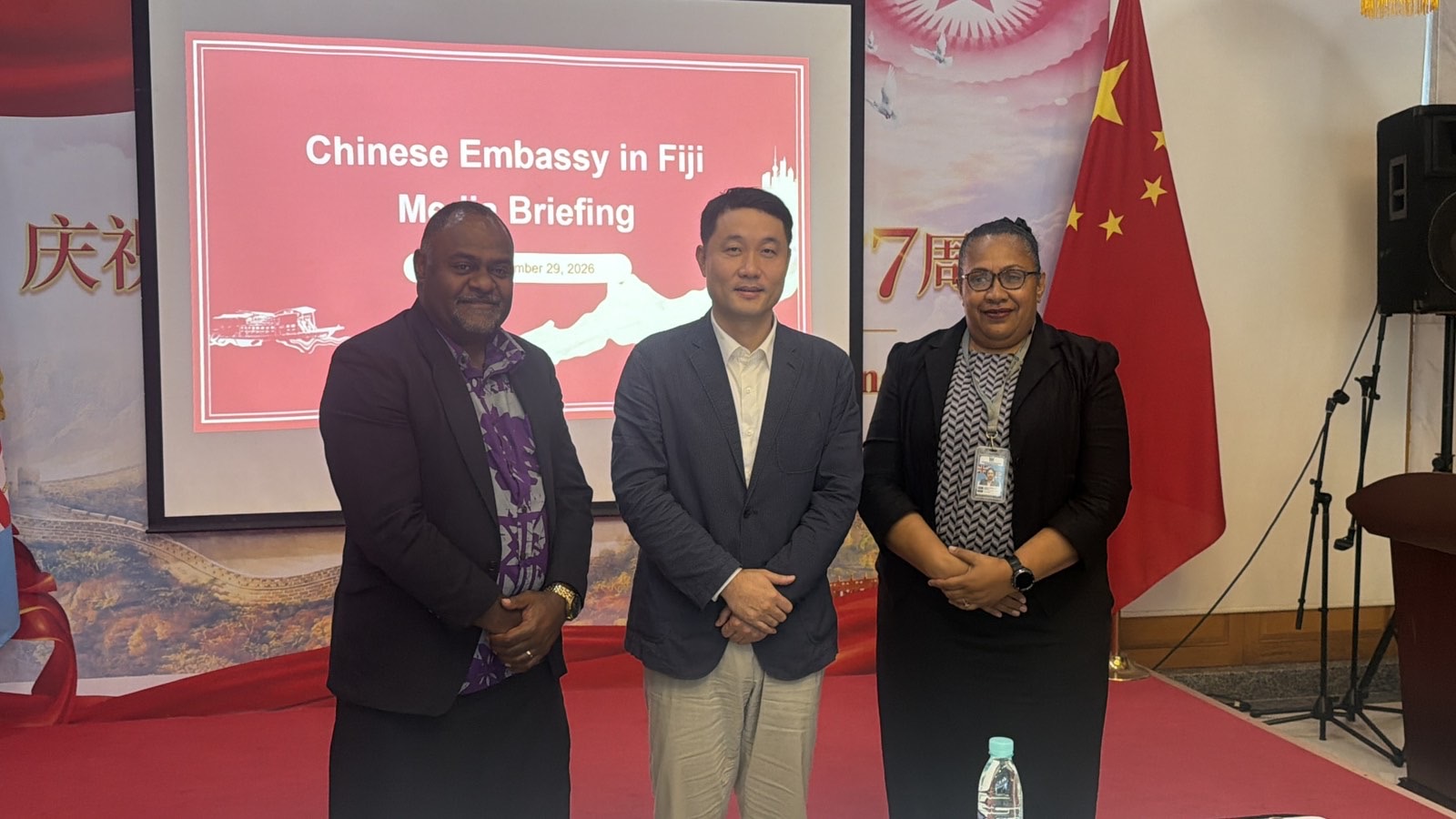
That was a key message from Fiji Bureau of Statistics representative and member of the 10th cohort of the China Executive Leadership Academy (CELAP), Maria Nabola, following a media briefing at the Chinese Embassy in Suva.
Nabola said the visit to China gave the senior public servants an opportunity to see how policies and development plans are translated into practical programmes and projects.
She said one of the main lessons was that good policy alone is not enough.
“Effective implementation, monitoring, and adaptation are equally important,” she said.
Nabola said Fiji and China differ significantly in size and circumstances, but there are still areas where Fiji can consider lessons from China’s experience.
She highlighted technology and digitalisation as another area of relevance, particularly as Fiji works towards modernising its statistical systems.
She said China’s use of digital platforms, smart-city applications, modern transport systems and technology in public and commercial services demonstrated how innovation could improve efficiency and accessibility.
For Fiji, she said this could include digital data collection, better integration of administrative data and stronger use of evidence in decision-making.
But Nabola stressed that Fiji should not simply copy another country’s development model.
“For us as public servants, the important question is not simply how advanced another country may be, but what lessons can be adapted appropriately to our own national circumstances,” she said.
She also pointed to China’s development experience in infrastructure, urban development and poverty reduction, saying development planning should remain connected to the well-being of people.
Nabola said this was particularly relevant for Fiji, where policies and programmes need to be grounded in the needs of communities and supported by reliable data and statistics.
She also identified opportunities for continued Fiji-China cooperation in public administration, leadership development, digital transformation, statistics, data management, infrastructure, climate resilience, education and human resource development.
Nabola said the value of the CELAP programme extended beyond professional training, with relationships built between participants and their Chinese counterparts also strengthening people-to-people ties.
She returned to Fiji with three key reflections from the programme, the importance of vision and long-term planning, strong implementation supported by capable institutions, and genuine partnerships and knowledge exchange.
She said the experience had given her new perspectives rather than a blueprint for Fiji to follow.
“I leave CLEP not with answers, but with better questions. I leave with a framework, not a blueprint, to adapt, not compete,” Nabola said.
The 10th cohort thanked the Chinese Government, the Chinese Embassy in Fiji, the Ministry of Civil Service and CELAP for the training and exchange opportunity, with Nabola saying the group looked forward to continued friendship and cooperation between Fiji and China.

Weather data gaps could limit growth of parametric insurance in...
Sep 30, 2026, 04:26 PM

Weather data gaps could limit growth of parametric insurance in...
Sep 30, 2026, 03:58 PM

Fuel and LPG prices will increase from tomorrow
Sep 30, 2026, 03:49 PM

New Caledonia Film Festival brings six short films to USP
Sep 30, 2026, 03:41 PM

Taxi fare extension gives operators more time
Sep 30, 2026, 03:36 PM
Weather data gaps could limit growth of parametric insurance in...
Sep 30, 2026, 04:26 PM
Weather data gaps could limit growth of parametric insurance in...
Sep 30, 2026, 03:58 PM
Fuel and LPG prices will increase from tomorrow
Sep 30, 2026, 03:49 PM
New Caledonia Film Festival brings six short films to USP
Sep 30, 2026, 03:41 PM
Taxi fare extension gives operators more time
Sep 30, 2026, 03:36 PM
 Fiji One News Team